

Manuka From Australia
Most folks familiar with Manuka honey think it comes only from New Zealand. This is completely inaccurate.
This impression is due mainly to the very strong marketing effort by the honey folks in New Zealand. They have done a great job in educating consumers about Manuka honey and its health benefits and we respect their effort and we send them our thanks.
The plant that the bees use to make Manuka honey grows in Australia as well as New Zealand and on this page we will present information that will confirm our assertion.
The Australian Government has made a number of studies. Here is some of the text of one important study followed by a link to the whole document.
Leptospermum scoparium (Manuka or Tea tree or just Leptospermum) is a shrub or small tree native to New Zealand and southeast Australia. It is found throughout New Zealand but is particularly common on the drier east coasts of the North Island and the South Island, and in Australia in Tasmania, Victoria and New South Wales. Manuka (from Maori ‘manuka’) is the name used in New Zealand, and ‘tea tree’ is a common name in Australia and to a lesser extent also in New Zealand. This name arose because Captain Cook used the leaves to make a ‘tea’ drink. The common name “Tea Tree” is also shared with the related Melaleuca tree of Australia suggesting that both were used to make tea by Captain Cook.
Manuka honey, produced when honeybees gather the nectar from its flowers, is distinctively flavoured, darker and richer in taste than clover honey and has antibacterial and antifungal properties. The finest quality Manuka honey with the most potent antimicrobial properties is produced from hives placed in wild, uncultivated areas with abundant growth of Manuka bushes.
UMF Grading System
The UMF Honey Association (UMFHA) says recent advances in science mean it is now possible to definitively identify genuine Manuka Honey.
UMFHA Administrator John Rawcliffe said, over the past four years, the Association’s members had been driving rapid advances in the application of science using high resolution mass spectrometry to the point where products claiming to contain genuine Manuka Honey can be readily authenticated.
“We have a comprehensive database of Manuka and other floral origin samples. These have been collected from across the length and breadth of New Zealand over the last three seasons and can be used to test for Manuka Honey. Once this receives final international verification, testing agencies in all our key markets will be able to use a web -based model to easily check Manuka Honey products as being true to type.”
John said the new data set will provide real assurance and long-term confidence amongst consumers and regulatory authorities in markets where Manuka Honey is sold.
“This will be a significant breakthrough for the industry, in terms of being able to differentiate Manuka Honey from other floral type honeys. We now understand in a much more comprehensive way the complex array of signature compounds that make Manuka Honey such a special product. This discovery offers the ability to differentiate and position genuine Manuka Honey apart from the raft of ‘me too’ products currently being sold.”
John said the new web-based analytical model is the latest innovation to be introduced by the UMFHA, following last year’s announcement at a Primary Production Select Committee of the discovery of the novel compound – Leptosperin – found in Manuka Honey.
Leptosperin is one of a number of key signature compounds found in Manuka Honey. It is relatively stable and cannot be easily synthesised. Leptosperin also fluoresces, which led to a New Zealand-based consortium developing a prototype portable fluorescence testing unit last year. Leptosperin was identified by leading international researcher Professor Yoji Kato of the University of Hyogo, Kobe.
“The discovery of Leptosperin, along with the development of our soon to be released analytical model, is yet another step forward in the Association’s industry-leading scientific programme which aims to assist international markets in identifying genuine Manuka Honey. Grading system : http://www.umf.org.nz/grading-system-explained/
This uses 3 keys components as a signature of genuine Manuka honey
Leptosperin - marker from the Manuka pollen
Methylglyoxal (MGO) - anti bacterial
Hydroxymethyl Furfural (HMF) -
In practical terms, a medicinal grade (UMF 15+ or above), Manuka honey could potentially be beneficial and may be used for, but is not limited to, the following conditions:
- Skin cuts/sores/wounds/ulcerations
- Mouth ulcers
- Sore throats, tonsillitis
- Gastric ulcers
- Infections of the digestive tract
- General immune tonic, to ward off potential infections.
MGO Grading System
More about MGO
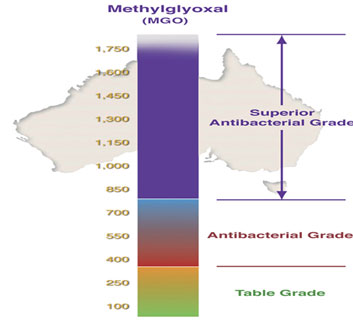
This chart shows MGO (or methylglyoxal) readings from low to high, encompassing those levels achieved by Berringa’s Australian Super Manuka Honey.
The higher the MGO reading the higher the antibacterial and antimicrobial levels of activity in the honey. To put it in context, an MGO of 400 means it is a potent bioactive honey that will have strong antibacterial activity, whilst MGO 900 means the honey is very potent and it is the strongest antibacterial manuka honey we offer. Berringa MGO 900 Super Manuka Honey is also the most potent manuka generally available in Australia and internationally.
- The MGO you choose really should be dependent on your intended use and how strong you want the antibacterial activity to be.
- It is delicious to eat, but it can of course be used topically.
- It contains antioxidants which can help protect the body from harmful free radicals.
- It can help support the immune system (it’s really useful to have handy when the cough, cold and sore throat season is with us!)
- It can help provide temporary relief from some gastric conditions, as well as relief from mouth ulcers, sore gums etc.
- It can also aid digestion.
- It is very useful as an aid with some skin conditions and the treatment of minor wounds.
Of course, if symptoms persist or you are concerned about any medical condition, you should see a healthcare professional as soon as possible. Your G.P. for example
Antimicrobial resistance (AMR) is an increasing clinical problem precipitated by the inappropriate use of antibiotics in the later parts of the 20th Century. This problem, coupled with the lack of novel therapeutics in the development pipeline, means AMR is reaching crisis point, with an expected annual death rate of ten million people worldwide by 2050. To reduce, and to potentially remedy this problem, many researchers are looking into natural compounds with antimicrobial and/or antivirulence activity. Manuka honey is an ancient antimicrobial remedy with a good track record against a wide range of nosocomial pathogens that have increased AMR. Its inhibitory effects are the result of its constituent components, which add varying degrees of antimicrobial efficacy to the overall activity of manuka honey
The full text of the summary above can be seen in the link: MFA-01-Australian-Teatrees
Other references
- Confirmation of Forestry Tasmania license for Blue Hills to collect Manuka Honey in Tasmania
MFA-09-ForestTas-2014 - Confirmation by Tasmanian Herbarium of Manuka in Tasmania
MFA-10-TH-TMAG-2014 - Confirmation by Minister of Economic Development of Manuka in Tasmania
MFA-11-MED-2014 - Confirmation by University Of Tasmania of Manuka in Tasmania
MFA-12-UTAS-2014 - Australian Government report on Floral Resources in Tasmania – Manuka and Leatherwood
MFA-13-RIRDC Report-TTrees-2014 - Confirmation by Novost of Manuka in Tasmania and the Novost testing of Tasmanian Manuka
MFA-14-Novohost-2014
Other Links
- MFA-08-Leptospermum-Dist in Tasmania
- MFA-05-Leptospermum-Tea-Tree
- MFA-02-Leptospermum-Aus-Plant1
- MFA-07-Leptospernum-Chart
- MFA-06-Leptospermum-In Aust
- http://www.anbg.gov.au/leptospermum/
- http://asgap.org.au/apol11/sep98-3.html
- http://bie.ala.org.au/species/Macklottia
- http://bie.ala.org.au/species/urn:lsid:biodiversity.org.au:apni.taxon:523255
 29 Quinn Drive, Keilor Park VIC 3042